Infographic: LGBT Health, Racial Disparities, and Aging—by the Numbers

Preview. Download the full infographic below.

Preview. Download the full infographic below.

Download the infographic LGBT Health, Racial Disparities, and Aging—By the Numbers, today!

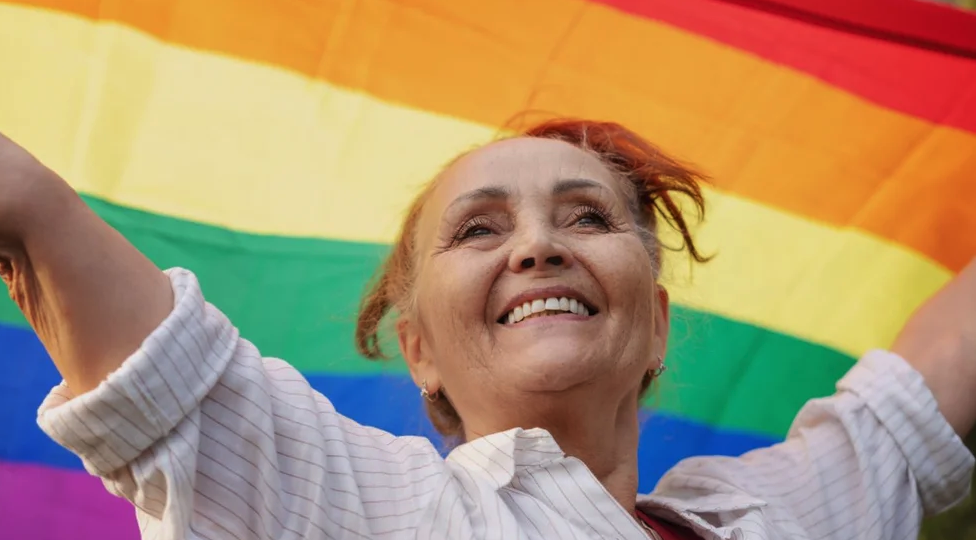
Americans who are people of color, older adults and LGBT identified (referred to in this blog post as LGBT elders of color) often have unique needs because of the intersections of identities. LGBT elders of color are historically marginalized on multiple fronts and their needs are often under addressed in the mainstream aging field and in the popular LGBT rights movement. Read More Read More

StoryCorps: A Transgender Woman’s Journey from Hiding to “Walking in Love”

Alexis Martinez (left) worried that coming out to daughter Lesley as transgender would mean giving up any relationship with her grandchildren. But she needn't have worried.

Alexis Martinez (left) worried that coming out to daughter Lesley as transgender would mean giving up any relationship with her grandchildren. But she needn’t have worried.

Alexis Martinez grew up in a rough neighborhood on Chicago’s South Side in the early 1960s. She knew she was transgender from an early age.Alexis (whose birth name is Arthur) struggled with her identity, as did her family. At 13, she came out as transgender to her mother. Alexis’ mother called the police, who laughed and told her, “You’ve got a fag for a son, and there’s nothing we can do about it.”

As a result, Alexis joined a gang and “went as macho as [she] could be, to mask what [she] really was underneath.”

Alexis has a daughter, who accepts her for who she is. Says her daughter Lesley: “You don’t have to apologize. You don’t have to tiptoe. We’re not going to cut you off. And that is something that I’ve always wanted you to, you know, just know—that you’re loved.” Read More Read More

A Gay Son and His Dad: “Why I am an Aging Advocate”

How my dad supported his gay son

There was a time in my life, around 11 years old, when I often skipped school because I was being bullied and harassed. It was obvious to my classmates that I was “different” and they targeted me because of it.  At lunch, there was a boys table and a girls table, but I was relegated to the “other” table.

I hated waking up for school. Sometimes I would put my head over the toaster to create a “fever” and ask my mother if I could stay home. Sometimes it worked. Sometimes it didn’t.  Those days that it didn’t, I would put on my uniform, grab my lunch and deliberately slam the front door to our apartment. The loud noise signified to my parents that I was on my way to school.

What I really did was tip toe back to my bedroom and hide in the closet. Inside, I would carefully listen for my family to leave for the day. Once they were gone, I would breathe a huge sigh of relief as it meant I could turn on the TV and relax—I was free from my bullies!

One Monday, the school administration called my mother to inquire why I hadn’t been attending. It just so happened my father was home that day and my mother demanded that he check to see if I was there.  As he called my name, my heart was pounding and I put my hand over my mouth to hide my breath as I hid in the closet. Read More Read More

The Re-launch is here!

Two weeks ago, we announced that we would be re-launching the Diverse Elders Coalition Blog.  Read here to find out more.

We are thrilled that this day has finally come. As we previously promised, in addition to our regular contributing bloggers, we will have exciting guest bloggers.  We will also display our content in a variety of different ways (e.g., pictures, videos, interviews, Top 5 columns, etc.) And much more! Have a suggestion? Contact us.

You can bookmark this page or subscribe to our RSS feed to stay updated. Check back on Wednesday to read our latest post, courtesy of National Hispanic Council on Aging (NHCOA). Until then, enjoy some highlights from the blog’s history:

1) Watch Our Story

2) The Unique Needs of Asian American and Pacific Islander Elders

3) 10 Considerations for Working with the Diversity of Older LGBT Latinos

We are Re-launching On March 18!

Share on Facebook and Twitter

Share on Facebook and Twitter

The Diverse Elders Coalition (DEC) was founded in 2010, and in July 2012 we launched our official website, which also serves as a news and commentary blog on the social, political and economic issues affecting the growing yet vulnerable demographic of elders who are Black, Hispanic, Asian/Pacific Islander, American Indian/Alaska Native, and lesbian, gay, bisexual and/or transgender (LGBT).In the last eight months, we have put out numerous posts on the issues that affect our communities and the creative ideas and best practices to address them. In the summer of 2012, we also released Securing Our Future: Advancing Economic Security for Diverse Elders, a resource that describes the issues facing elders of color and LGBT elders, who together will represent a majority of older adults in the United States by 2050.

In this time, we have received some wonderful comments on our work, as well as helpful feedback from our readers (all of you) on how to improve the site to better meet your needs—and we listened to you. Members of the Diverse Elders Coalition came together and crafted an exciting plan for moving forward by implementing many of your ideas, which you’ll see starting with our blog re-launch on March 18.  Here are some of the improvements to look forward to:

  • In addition to our regular contributing bloggers, we have some exciting guest bloggers scheduled!
  • Content displayed in a variety of ways (e.g., pictures, videos, interviews, Top 5 columns, etc.)
  • More news and original content from coalition members
  • And more!


As we look forward to March 18, please like us (and tell a friend!) on Facebook to stay updated on the events surrounding the launch and the latest news affecting diverse elders. If you have any questions about DEC or would like to submit an idea for a blog post, please contact us.

See you on the 18th!

To learn more about DEC members, click here.

HIV/AIDS is Still an Issue for Older Gay Black Men

In honor of Black History Month, the SAGE Blog will feature a post on LGBT aging in the black community every Thursday during the month of February. February 7 is National Black HIV/AIDS Awareness Day, so our first post in the series is on HIV/AIDS in the black community by Ty Martin, Community Liaison at SAGE Harlem.

Ty Martin & SAGE Constituent Sherman Walker

Ty Martin & SAGE Constituent Sherman Walker

I am black.  I am gay.   I am an older adult. 

I am resilient. And so is my community.


I grew up during the civil rights movement, seeing powerful black activists around me fight for our civil rights as a people.  I also grew up during the Stonewall Riots, feeling the hostility society harbored toward lesbian, gay, bisexual and transgender (LGBT) people.  And I grew up during a time when I lost many loved ones due to HIV/AIDS, a disease that was viewed by the world as a critical epidemic.

Now it’s 2013. Today as a black gay man, I enjoy more freedoms and rights (as a New Yorker, I have the right to marry my long-term partner Stanton). Yet, for older black gay men who are living with HIV/AIDs, it’s still a difficult journey.

Continue reading this article>>>

Honoring MLK Day of Service: How One Volunteer Gives Back to Her Community

January 21, 2013 will mark the official Martin Luther King Jr. (MLK) Day of Service, empowering individuals and communities to come together and volunteer their time to get involved and give back. Americans are encouraged to help out where they can, whether it’s serving food at a soup kitchen or organizing a clothing drive for those in need. Together, we can begin to create solutions to social problems, moving us closer to Dr. King’s vision of a beloved community.

Shelly Montrose, an older African American lesbian from Harlem started giving back because of her friend. Read her story here.


SAGE Wants to Hear from more Communities of Color

Services & Advocacy for GLBT Elders (SAGE) is working on our next strategic plan to help guide the organization for the next few years, and we need your help. SAGE has a long history of listening to the many audiences we work with, and we would like to hear your thoughts on our work on behalf of lesbian, gay, bisexual and transgender (LGBT) older adults. Read More Read More

LGBT Older Americans Cannot Afford to Go Over the Fiscal Cliff

The following is a guest post by George Stewart, SAGE constituent.

Not long ago, the Washington Post reprinted a letter signed by a group of lesbian, gay, bisexual and transgender (LGBT) millionaires asking Congress to come to a resolution on the “fiscal cliff” by preventing across-the-board spending cuts to federal programs, preserving tax cuts for the middle class and allowing tax cuts for the wealthiest to expire.  As heartened as I was to see some LGBT voices in the public debate on economic issues, I wondered how many people know how the impending spending cuts will impact a vast majority of LGBT older people throughout the country—people like me.

I have spent much of my life looking for where I fit in, while striving to serve my country and my community. I’ve witnessed intolerance in my life, as well as positive change. In the 1950s, I was a black soldier in a segregated Army unit stationed in the South. I found a lot of camaraderie with the soldiers in my unit, but we always felt that we had to go above and beyond—if another outfit shined the tops of their shoes, we’d shine the bottom of ours. I was stationed last in Louisiana, where one of my most vivid memories is being singled out by a policeman because he thought I was sitting too close to a white woman in a public park. When my enlistment ended in Louisiana, I decided that I would move to New York City.  I hoped my move would lead to better things—an opportunity to be an individual in a big city, instead of being viewed as just a black man inappropriately sitting down next to a white woman. Read More Read More

10 Considerations for Working with the Diversity of Older LGBT Latinos

Effective outreach begins with a plan and developing a plan requires research. Yet, anyone trying to develop an outreach plan for older lesbian, gay, bisexual and transgender (LGBT) Latinos can quickly feel as if he or she is hitting one brick wall after another—there is simply a lack of resources dedicated to this community.  Sure, you may be able to find strategies on how-to engage seniors, LGBT youth or the Latino population at large, but these strategies do not speak to the unique experiences and challenges faced by older LGBT Latinos.

For those of you whose organizations are trying to better engage this community, you may simply need a place to start. You may wonder, “What are the most effective outreach techniques to reach Older LGBT Latinos?” As the former Outreach Coordinator for SAGE Harlem (a program for LGBT older adults serving a significant Latino population), I have asked myself the same question. Through trial and error, I have been able to identify the top ten considerations for working with the diversity of older LGBT Latinos.

Read More Read More

A Federal Bill for LGBT Elders

Last week, Sen. Michael Bennet (D-CO ) introduced a bill that could improve supports for millions of LGBT elders through the Older Americans Act. SAGE has been working on this issue for almost three years — from raising awareness and producing policy reports, to hosting Congressional briefings and securing support from the influential Leadership Council of Aging Organizations, to working closely with Sen. Michael Bennet (D-CO) and various aging groups in DC.

Read my recent editorial in The Huffington Post about this bill’s importance to LGBT elders. Read More Read More

Looking to Harlem – Creating a Safe Space for the Older Black LGBT Community

Harlem is undoubtedly one of the most well-known African-American neighborhoods in NYC and the nation. Part of its rich history includes the Harlem Renaissance, a literary movement celebrating black cultural identity in the 1920s and 30’s. It is also home to the Apollo Theatre, a cultural landmark that has hosted influential black icons and leaders such as President Barack Obama, Chaka Khan and Michael Jackson. What might not be as well-known, however, is that there are a number of local black and gay-owned businesses in the community such as Harlem Flo and Billie’s Black, showcasing that lesbian, gay, bisexual and transgender (LGBT) people exist in Harlem.

There is also a significant aging community. One in three Harlem residents are age 50 and older, according to 2006 estimates from The New York City Department of Health and Mental Hygiene. And as an outreach coordinator for SAGE (Services and Advocacy for GLBT Elders), I also know well that a significant number of these older adults are LGBT.

Read More Read More

An LGBT-Inclusive Older Americans Act

The Older Americans Act (OAA) serves as the country’s leading vehicle for delivering services to older people nationwide, providing more than $2 billion annually in nutrition and social services. Since its enactment in 1965, the OAA has aimed to ensure that older people have the supports they need to age in good health and with broad community support. It places an emphasis on more vulnerable elders who face multiple barriers that can aggravate economic insecurity, social isolation, and various health challenges related to aging.

Yet strangely, despite ample evidence of their heightened vulnerability and their need for unique aging supports, lesbian, gay, bisexual and transgender (LGBT) older people are invisible in this landmark law. As the OAA comes up for reauthorization, and as millions of LGBT people enter retirement age, Congress should ensure that the OAA supports all elders, including those who require unique supports. LGBT older adults should be written into the framework of the Older Americans Act.

Read More Read More